Singapore built the MRT without lifts on purpose
You have taken this train.
Every MRT station has a lift now. When the system opened in 1987, not one did.
That was not an oversight.
It was a decision. Argued in public. Defended in the papers. Won.
The Straits Times, November 1983. The MRT Corporation's director explains.
Trains stop for "30 seconds at the most." So one has to be "reasonably agile to get in and out."
Reasonably agile.
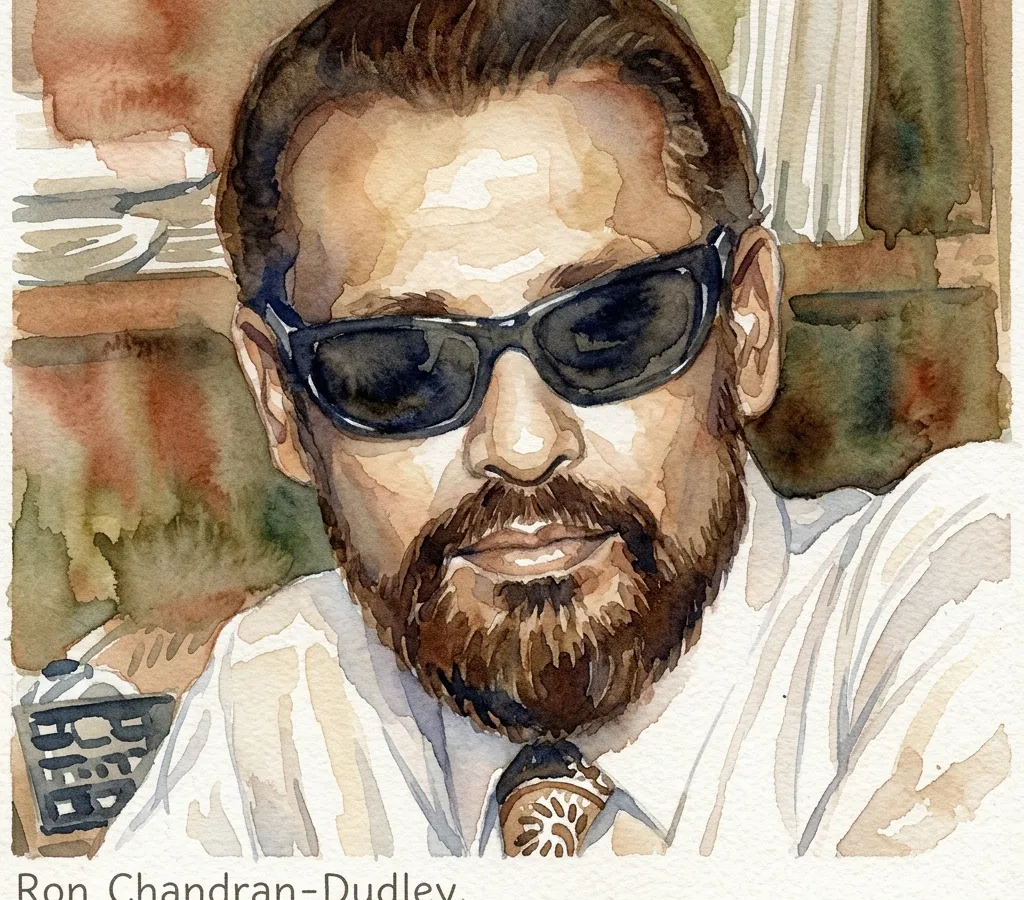
The man arguing the other side was Ron Chandran-Dudley.
He was blind.
Elected two years earlier. First world chairman. The global disability rights movement.
It was founded in Singapore.
He lost.
Here's what I didn't know until recently. He'd had this fight before. And won it.
Ron was born in 1934. Only child, Ceylonese family. Raffles Institution, 1947 to 1951.
He was going to be a brain surgeon. He had a place to read medicine in England.
Then a rugby match. 1952. A kick to the head.
He never saw again.
April 1953. He walked into the Singapore Association for the Blind.
Not as a client. As a volunteer. Handing out aid.
He found a working system. White canes. Badges. Food. Clothing. Medical care.
All of it decided by people who could see.
"Why can't we give the blind back their dignity?"
So he left.
London School of Economics. Social anthropology. Then Albany, New York, on a Fulbright.
Master's degrees. Rehabilitation counselling. Psychotherapy. Sociology.
His wife Rena put him through the last of it.
He came home in 1971.
He took the general secretary's job. At the association he'd first walked into with a box of handouts.
## The vote they lost
Rehabilitation International was the establishment. Founded 1922. Members in a hundred countries.
Doctors. Governments. Academics. Charities.
June 1980. It held its world congress in Winnipeg.
Before it opened, a Swedish delegate moved an amendment. Bengt Lindqvist. One line of definition.
To count as an organisation of disabled people, a body had to be at least half disabled people.
Half. Not all.
It was voted down. 61 to 37.
Lindqvist carried the result into a side meeting.
Two hundred and fifty disabled people were sitting in it. Forty countries.
Henry Enns, a Canadian delegate. He said the vote made them realise "the only way they would gain a voice was to form their own organization."
They didn't appeal.
They split off, while the congress carried on down the hall.
Four days later, three hundred delegates voted. Unanimously. Build our own.
The founding text is blunt. Membership was open to organisations "OF" handicapped people.
Meaning "decisive control" sat "in the hands of the handicapped."
Not a seat on the committee.
The committee.
## A congress with no money
They needed a founding congress. The steering committee picked Singapore.
They picked late 1981. The UN had named it the International Year of Disabled Persons.
Then they had to pay for it.
The budget was $240,000. Half the delegates couldn't afford to come.
Flights had to be booked months ahead. Fifty people. Twenty-five developing countries.
By telegram and telex. Before the money existed.
The Winnipeg office had $20,000 in the bank.
It opened $120,000 of credit with travel agents. Against letters promising funding.
Diane Driedger did the booking.
"I'll tell you, I was scared, and Jim was scared, but Henry was not scared."
In Singapore, Ron mortgaged his house.
Four hundred disabled delegates arrived on 29 November 1981. Fifty-one countries.
All but three of the subsidised ones got their tickets in time.
On the second-to-last day, the money still hadn't come. Not from the UN. Not from Canada's aid agency.
The hotel wanted $20,000. The organisers were facing arrest.
A colleague in Winnipeg took a UN telegram to his bank. He borrowed against it.
Canadian External Affairs moved the cash by diplomatic channels.
The High Commissioner's office delivered it to a hotel room. The final morning.
That afternoon, 4 December 1981, the congress elected Ron. First world chairman.
His motto was four words. A Voice of Our Own.
He did the same thing at home that year. He used a preposition.
The members of the Singapore Association for the Blind rewrote their own constitution.
Now the board was majority-blind.
The way he told it. The Singapore Association for the Blind became the Singapore Association of the Blind.
One word. Everything downstream of it moved.
## Then Singapore announced the MRT
30 May 1982. The government said it was building a metro.
Ron wrote to the Straits Times as world chairman of DPI.
He pointed at the congress his own city had just hosted. Its main thrust had been "equality, full participation and solidarity."
So Singapore was "now morally bound to break down all barriers."
The reply came in instalments.
The MRT Corporation said escalators shift crowds better than lifts. Escalators don't take wheelchairs.
It would not be "in the interests and safety" of wheelchair users to be "caught up in the hustle and bustle" of a station.
The government said the aim was "to discourage them from using the MRT."
Because "in the event of a calamity, handicapped people would be trapped."
The ministry said one system cannot meet "the specific requirements of certain segments of the population."
It suggested the disability groups come up with schemes of their own.
Every one of those is a sentence about safety.
None of them is.
So Ron changed the argument.
He stopped asking for rights. He started quoting a number.
"Many of us are indeed tax payers," he wrote. "And many more could be tax payers if we had access."
Then the line that gave the letter its headline.
"To be economically viable, the MRT should aim for maximum clientele."
Maximum clientele.
That's a man who founded a human rights movement. Writing to a newspaper in the language of a fare box.
He'd worked out which language the room spoke.
It still didn't work.
The MRT opened in 1987. No lifts.
Handicaps' Monthly was the magazine Singapore's disabled community published themselves. Its editorial ran one line worth keeping.
"The disabled will soon be forgotten."
He'd argued it since 1983. The decision came in 1999.
And it came for the wrong reason.
That year the Minister for National Development announced lifts and ramps for the existing stations.
The reason in the papers wasn't equality. It wasn't dignity. It wasn't the 1981 congress.
It was that Singapore was getting old.
The same minister ran the committee on the ageing population.
The frail elderly were about to become a very large number.
A very large number is an argument a treasury understands.
Sixteen years. He was right the whole way through.
Being right was never the thing that moved it.
Being counted was.
That's the hard half of his story. He worked it out early.
From 1953 to 1980 he learned the first half. You cannot win a room you're only allowed to sit in.
So he built his own room.
It worked. The movement he chaired runs in more than ninety countries now.
Then he spent the eighties on the second half.
A room of your own gets you a voice. It does not get you a lift.
For that, somebody has to put you on a spreadsheet.
He did both jobs. He founded the Disabled People's Association here in 1986. Singapore's first.
He kept writing letters.
Singapore signed the UN disability convention on 30 November 2012. Last country in Southeast Asia to sign.
Thirty years after he hosted the congress that wrote the argument for it.
He lived to see it. He died in December 2015, at 81.
Every station has a lift now.
What's something you're right about that nobody has counted yet?