Singapore's master potter still won't call himself an artist
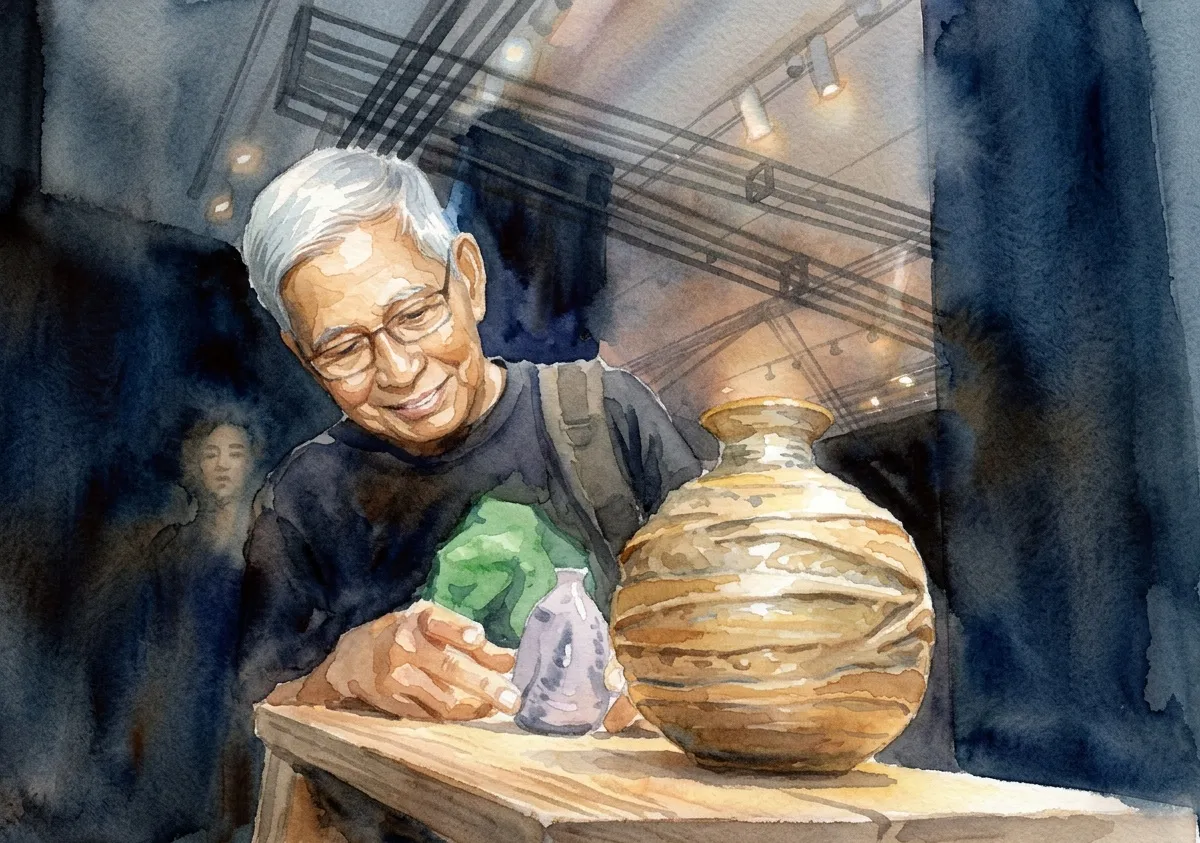
A hundred cups a day.
Same shape. Same weight. Same motion, over and over.
Four weeks of it. His teacher stamped one.
Not one a day. One.
The man at the wheel was a Singaporean schoolteacher. Maths and science.
Thirty-two years old. On a government scholarship. In a town called Tajimi, in Gifu prefecture.
He had not gone to Japan to make art.
He had come to study engineering.
Iskandar Jalil grew up in Kampong Chantek. Off Bukit Timah. Eldest of five.
His job as a boy was fetching wood. For the cooking fire.
His father, Abdul Jalil, had trained to be a doctor. King Edward VII Medical School.
Then his own parents died. He walked out of it.
He became a teacher instead. Later a government auditor. A career built out of the wreck of a different one.
The son became a teacher too. Victoria School. Teacher's Training College in 1962. Maths and science.
Then a headmaster noticed he could draw.
That is the hinge of the whole story. Nobody wrote his name down.
Iskandar was moved across to art. In 1966 a Colombo Plan scholarship sent him to Nasik, in Maharashtra. Textile printing and weaving.
Cloth. Not clay.
He came home. A schools inspector spotted him. Dropped him into a brand-new place called the Baharuddin Vocational Institute. Teaching pottery.
Baharuddin was no art school.
It opened in 1971 to serve industrialisation. Advertising art. Dressmaking. Furniture. Printing.
Skilled hands for factories. The country had just decided it needed them.
Here's what I didn't know until recently:
The second scholarship wasn't for art either.
## What he went there to learn
It sent him to the Tajimi City Pottery Design and Technical Centre. Ceramic engineering. Bodies, glazes, kilns.
The science of things that have to hold.
Tajimi, the mecca of ceramics.
He lodged with a foster family in Chikusa. The Miwas. Up at half past five. Train to Tajimi. Then half an hour on foot.
Mornings were two hours of Japanese phonetics and grammar. Afternoons, technical Japanese.
Evenings, two more hours of tea ceremony and flower arrangement.
"The training was tough and rigorous," he said later. "The idea is to fully immerse you in their language and culture."
And underneath all of it, the cups.
"A hundred cups a day. For one week, two weeks, four weeks. I had to make these cups, till the day the sensei finally placed his stamp on one. At first, I did not understand. Why did he stamp his seal on a cup that I made?"
Think about what a month of that does to a person.
No praise. No corrections. No explanation.
Just the wheel. The same object. Thousands of times.
Then a seal on one of them.
"I realised that was the sensei's approval — that I had graduated from this form of pottery, and could move on to another form. This is what becoming an artisan is about."
He came home a potter.
Nobody had sent him to become one.
## He brought the method home
They asked him to start the pottery department at Baharuddin. He did.
Then Temasek Polytechnic's School of Design, until he retired in 1999. Then NAFA. Community centres. Weekly lectures at NUS. External examining for colleges in Australia and Malaysia.
He taught the way he had been taught.
Latecomers found the door locked. Assignments had to be handwritten.
And work that wasn't good enough went out of the window. Fifth floor.
His students called him the Flying Missile.
There is a garden at the pottery centre. Strewn with broken pots. Not accidents. Rejects, in the open, where everyone walks past them.
A pottery graveyard.
The film director Royston Tan trained under him. One of Tan's pots was thrown out. Too smooth.
Raku clay stays rough.
And then this, from the same man:
"I give marks to students who made mistakes and the other students who got it right were angry with me."
Somewhere in those decades, people started calling him an artist.
He has spent fifty years declining.
"If a teapot cannot pour water properly, or if a ceramic tile warps, what is its use? An artist may create works without function, but for a craftsman, function must come first."
He calls it the ethical pot. Function first. Everything else after.
He means it as a warranty. Not a philosophy.
"If you have one of these and it leaks, bring it to me and I will give you a new one."
On collectors who put his teapots behind glass:
"I feel uncomfortable to see my pots displayed on top of sideboards, display cupboard, instead of they been used for what I intended for."
A pot on a sideboard is a pot that failed.
## Then he noticed an absence
1991. Stockholm. A solo show called Singapore Pottery.
He was there a week. He kept looking at Swedish pots. No blue in them.
Blue sea. Blue sky. Blue in the flag.
None of it in the clay.
So he went home and built the colour himself. A vivid barium blue. Cobalt carbonate and oxide.
This is where the engineering finally pays.
He wasn't guessing. He was a science teacher. He had spent a year in a technical centre. He knew what oxides do at temperature.
Reduction fired at 1,300 degrees. Two gas kilns. Run for over twenty years.
He digs local clay wherever he can. Alexandra. Seletar. Tampines. Jalan Bahar.
People started calling the colour Iskandar blue.
He didn't. "People have called it 'Iskandar Blue'" is as far as he'll go.
Singapore gave him the Cultural Medallion in 1988. That same year his mural went up at Tanjong Pagar MRT. Two years later, another at Changi Terminal Two.
His pots went to Lee Kuan Yew. To George H.W. Bush. To the Sultan of Brunei. To the National Museum of Sweden.
A teapot sold for $300 in 1990. By 2010 the small pieces started at $800. The large ones reached $6,000.
Then, in 2000, he went back to Japan. His old teacher called him a master potter.
Twelve years after his own country had.
Read that again. The state honour came first.
The word he was actually working for came from the man with the seal. Twenty-eight years after he sat down at that wheel.
Then his body started going. His right hand lost function. His right eye lost ninety per cent of its sight.
He learned to throw one-handed. Left hand inside the pot. Finding the wall by feel.
In September 2014 he told people. Stage 4 prostate cancer.
He kept making pots.
The next year the Emperor of Japan decorated him. Order of the Rising Sun, Gold Rays with Rosette. First Singapore artist ever to get it.
In 2016, an honorary doctorate from NTU. Then a retrospective at the National Gallery. Kembara Tanah Liat. Clay Travels. A hundred and eighty pieces. Fifty years of work.
Here's the thing about the word he won't take.
"Artist" has no test. You can call yourself one this afternoon. Nobody is allowed to check.
"Craftsman" comes attached to a teapot that has to pour. And a tile that has to lie flat.
It can be failed. That is the entire appeal.
He picked the title that could be taken away from him.
Then he spent twenty-eight years earning it. From the one person whose opinion he wanted.
Whose approval are you working for? Does that person know?