Ichiran Ramen / Manabu Yoshitomi
He discovered that what people see while eating changes the taste. So he removed everything -- the chef, the diners, the conversation. 90 stores later, people queue for 10 days.
There's a ramen shop where nobody talks to you.
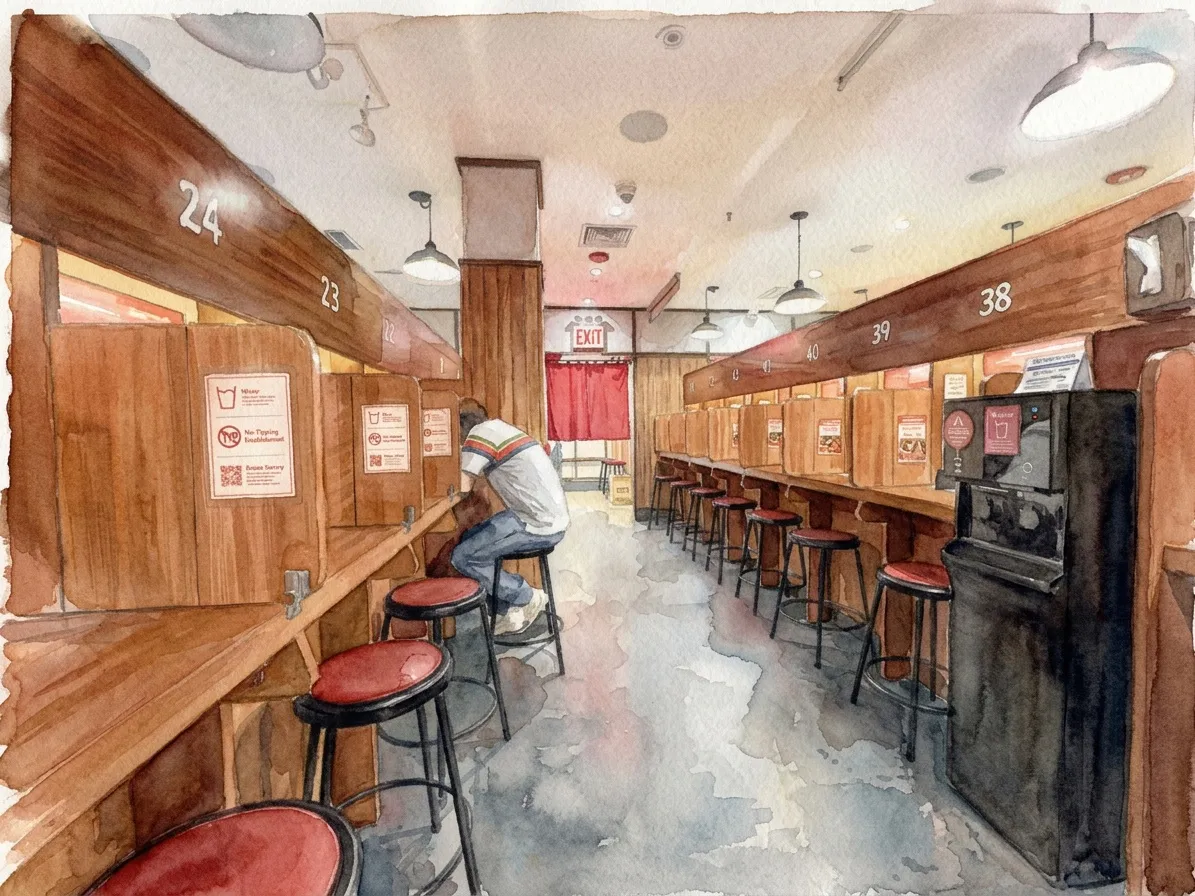
Partitions on both sides. Bamboo curtain between you and the kitchen. Paper form. Press a button. Curtain lifts. Anonymous hands. Curtain closes. Bowl appears. No words spoken.
Sounds like the worst restaurant concept ever.
People queued for over 250 hours straight when it opened in Taipei.
Here's what I didn't know until recently:
Manabu Yoshitomi was 19 when his father got cancer. Took a part-time job at a ramen stall in Fukuoka. The owner spent most of his time playing pachinko, so Yoshitomi taught himself to cook by watching.
Then two things planted the same seed.
As a teenager, he'd noticed female friends covering their mouths while eating ramen. Fukuoka's ramen scene was built on yatai -- cramped late-night street stalls packed with salarymen. Women felt like outsiders.
At the restaurant, a regular told him his ramen was worse than the owner's. Same recipe. Same ingredients. Next time, Yoshitomi cooked out of sight. The customer called it masterful.
Same ramen. The only variable: whether you could see who made it.
Two observations, one conclusion: what people see and feel while eating matters more than the food itself.
Before he could act on it, six years of failing. Computer sales. Staffing agency. Poverty. His one treat: ramen from an elderly couple who made a red sauce he couldn't stop thinking about.
When they got too old: "We don't need money. Would you take over?"
1993. Fukuoka. The solo booths were born. He called it "flavor concentration" -- remove every distraction so your senses fully absorb the bowl. No anxiety. No bias. Just you and the ramen.
It worked. Women now make up 40% of Ichiran's customers.
Then it nearly ended. The day after paying bonuses, his executive director and 30 employees walked out at once. Yoshitomi wrote a suicide note and fled to Kyoto.
Sitting alone, he overheard an elderly couple say: "Let's go back to the starting point."
He went back. Rebuilt from nothing. Created 108 principles around one idea: cherish people's hearts. The man who removed human interaction from dining became obsessed with it behind the scenes.
Today: 90 stores. 43 billion yen revenue. One menu item. Secret recipe known to four people who never fly on the same plane. Every bowl reaches the customer within 15 seconds of plating.
Sometimes the best experience isn't adding more. It's removing everything that gets in the way.
What's a product you love because of what it takes away?
This is the LinkedIn edit — written to fit inside 3,000 characters.
This ran on LinkedIn on 11 April 2026. See the original post · 104 reactions