E.W. Barker
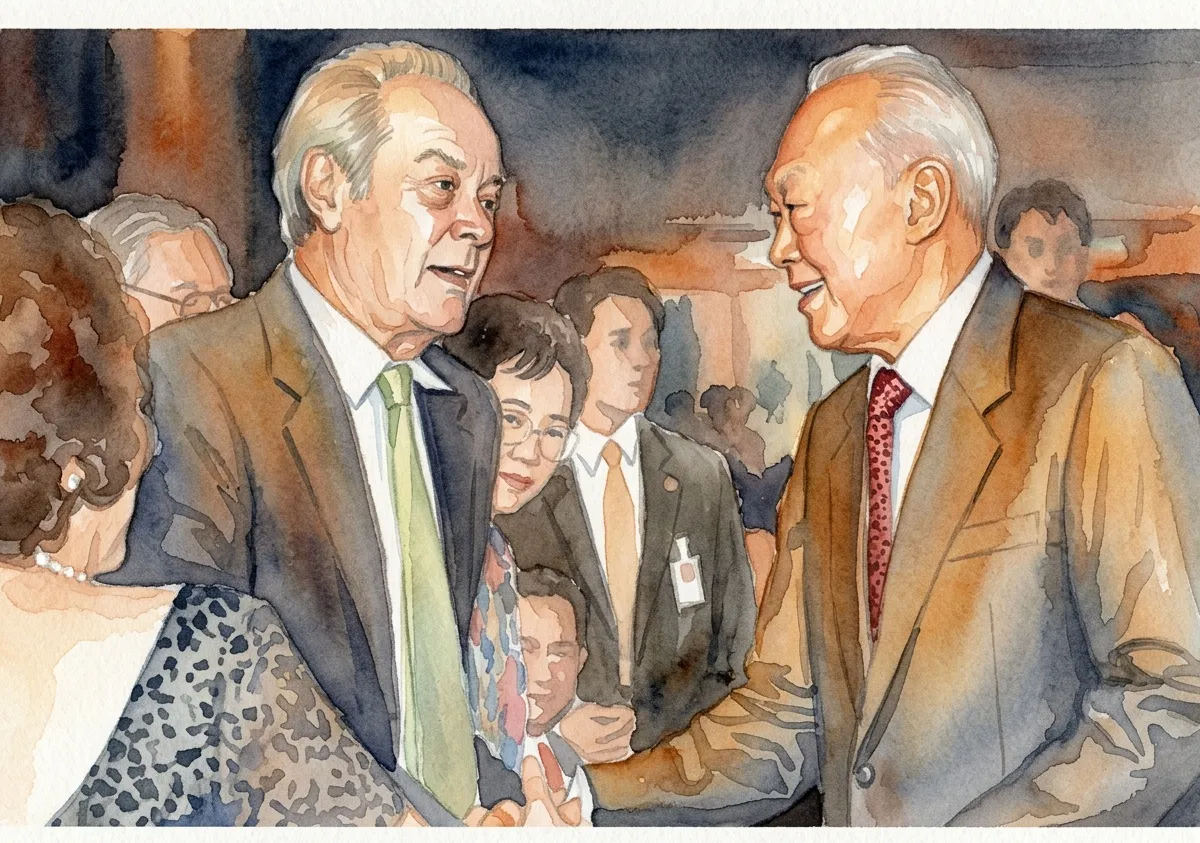
The father of a nation gets the statue; the man who wrote the paperwork gets forgotten — and Barker engineered his own anonymity.
Every 9 August, I stand for the pledge and watch the fireworks like every other Singaporean.
And for most of my life, our founding story had exactly one name in it.
Here's what I didn't know until recently.
When Singapore left Malaysia in 1965, it wasn't legal.
Read that again. The Malaysian Constitution had a provision for states to JOIN the federation. It had none for a state to LEAVE. On paper, separation wasn't a hard decision. It was an impossible one. There was no exit door because nobody had ever built one.
So somebody had to build it.
His name was Edmund William Barker. Eddie. A Eurasian lawyer, Cambridge-trained, Singapore's first Law Minister. Lee Kuan Yew handed him a problem with no legal answer and roughly a week to solve it.
At a meeting on 20 July 1965, Goh Keng Swee told the Malaysian side: "Eddie Barker will try a draft which we will show them in a week to 10 days' time."
Think about that for a second. The birth of a country, outsourced to one man and a deadline.
The Malaysians insisted civil servants be kept out for secrecy. So Barker did it alone. In about ten days he drafted three documents from scratch — the Separation Agreement, the Proclamation of Singapore, and the constitutional amendment that turned an illegal act into a lawful one. He didn't argue the country out of Malaysia. He wrote it out.
Just after midnight on 7 August, the papers were ready to sign.
And here's the part nobody talks about.
Barker signed first on the Singapore side. But he left a blank space above his own signature. On purpose. Empty room, so the senior men could sign over him and be remembered instead.
He handed the documents to Lee Kuan Yew, who looked at them and said: "Thank you, Eddie. This is a bloodless coup."
Barker went on to serve as Law Minister for 24 years, the longest ever. Wrote the law that protects our national monuments. Drove the building of the National Stadium.
Then he faded into a footnote in a story he personally wrote.
We remember founders because founding stories need one name. But somebody drafts the paperwork. Somebody builds the door that history walks through.
This year on 9 August, I'll know one more name than I did last year.
Whose is the name behind a story you thought you already knew?
This is the LinkedIn edit — written to fit inside 3,000 characters. Newer stories are written in full first, and the newsletter gets the whole thing.