Lim Chee Guan
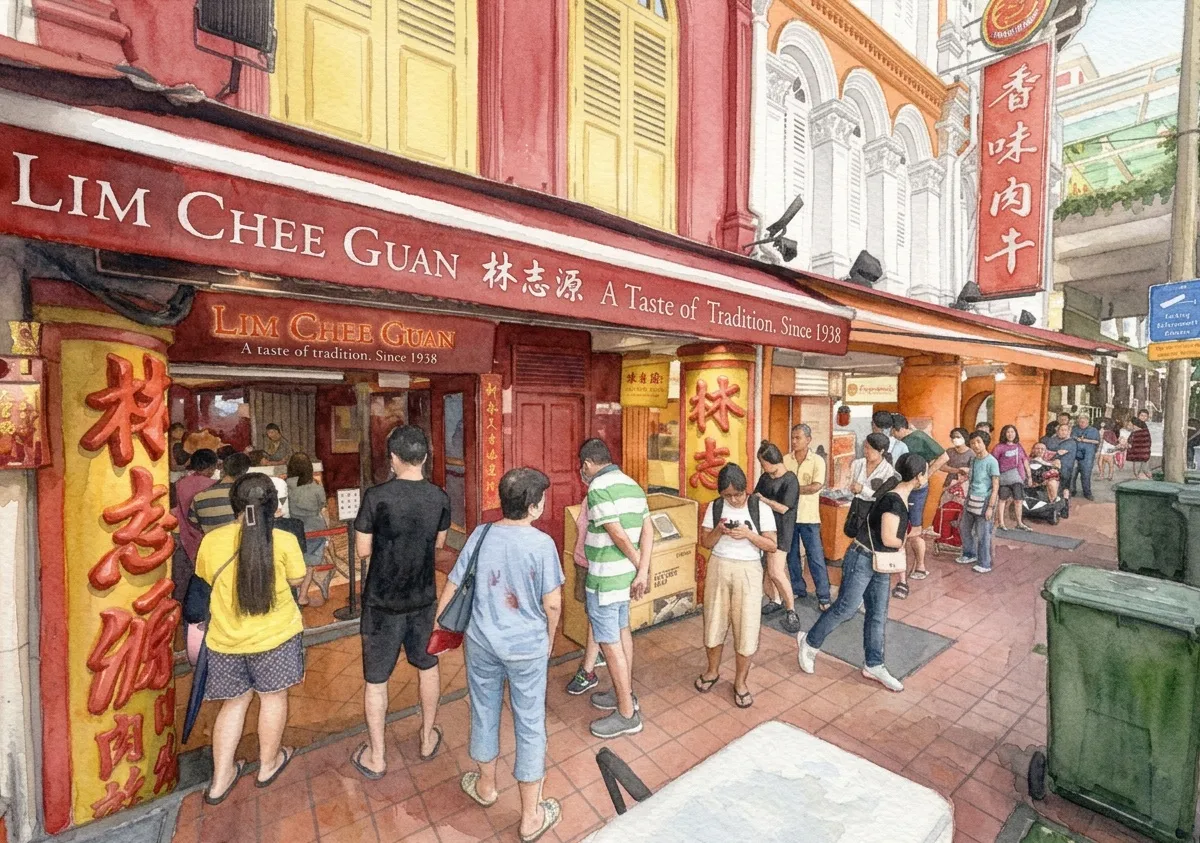
The queue is the receipt — proof of a standard they refuse to lower.
Every Chinese New Year, there's a line outside a shophouse on New Bridge Road that runs the length of a football field.
People queue six, seven, eight hours for it. Some show up at 4am. In 2017, migrant workers waited through the night. All of it for dried pork.
If you've spent a CNY in Singapore, you know exactly which shop I mean.
Lim Chee Guan.
Here's what I didn't know until recently: the man who started it never wanted any of this.
In the 1920s, a teenager from Xiamen named Lim Kay Eng got on a boat to Singapore. His parents wanted him to study medicine back in China. He loathed studying. So he left, worked plantations and coffee shops, and eventually set up a pushcart selling bak kwa off a recipe he'd learned from his mother.
The street he picked, Chin Chew Street, was famous for one thing: Cantonese and Hokkien secret societies brawling right next to his cart. In 1956, he moved to New Bridge Road to get out of the crossfire.
That "survival move" became the most famous bak kwa address in the country.
But here's where it gets interesting.
Machines exist that could do what Lim Chee Guan does many times faster. Conveyor grills. Automated lines. The third generation, Benny and Jerre, came in during the 2000s and saw exactly that case. Faster production. More output. Clear the queue.
The family said no. Machines slice the raw pork slabs, and that's it. The marinating, the hand-spreading, the charcoal-grilling — still done by hand, the way Kay Eng did it. Rod Lim, the second-generation owner, put it plainly: "I don't want to fail my father."
Now think about that for a second.
This isn't a company keeping the line long on purpose. They've tried to serve more people, not fewer — four outlets, a bigger factory, online pre-orders. Their website once crashed and got pulled after a single day because demand buried it.
The queue isn't a marketing trick. It's arithmetic. When you refuse to let a machine touch the part that matters, there's a hard ceiling on how much pork you can make. The line is just what that ceiling looks like from the street.
So the eight-hour wait isn't a failure of logistics.
It's the receipt.
Every hour someone stands in that line is proof the family didn't take the shortcut. The boy who refused to become a doctor built something his customers will burn half a day to hold — because he never let it get quietly worse.
What's something you'd happily queue hours for, that you'd never accept a faster, cheaper version of?
This is the LinkedIn edit — written to fit inside 3,000 characters. Newer stories are written in full first, and the newsletter gets the whole thing.