Jurong Island
When you don't have the resource, become the place where the resource gets processed.
In the 1960s, Singapore had a problem no one wanted to talk about.
14% unemployment. No natural resources. No oil. No gas. No minerals. A tiny island with two million people and nothing to sell.
The Finance Minister, Goh Keng Swee, had an idea. Build a massive industrial estate in Jurong — a swampy, mosquito-infested wasteland on the western end of the island.
Everyone laughed.
They called it "Goh's Folly."
Roads full of potholes deep enough to swallow a wheel. No trees, no grass. Workers had nothing to do on weekends except walk to a lake. The government built open-air cinemas and put boats on the water just to keep people from quitting.
The EDB went door to door trying to convince companies to invest. They managed to secure exactly two: a steel mill and a textile factory.
Two.
But Goh didn't stop. "The only way to avoid making mistakes is not to do anything," he said. "And that will be the ultimate mistake."
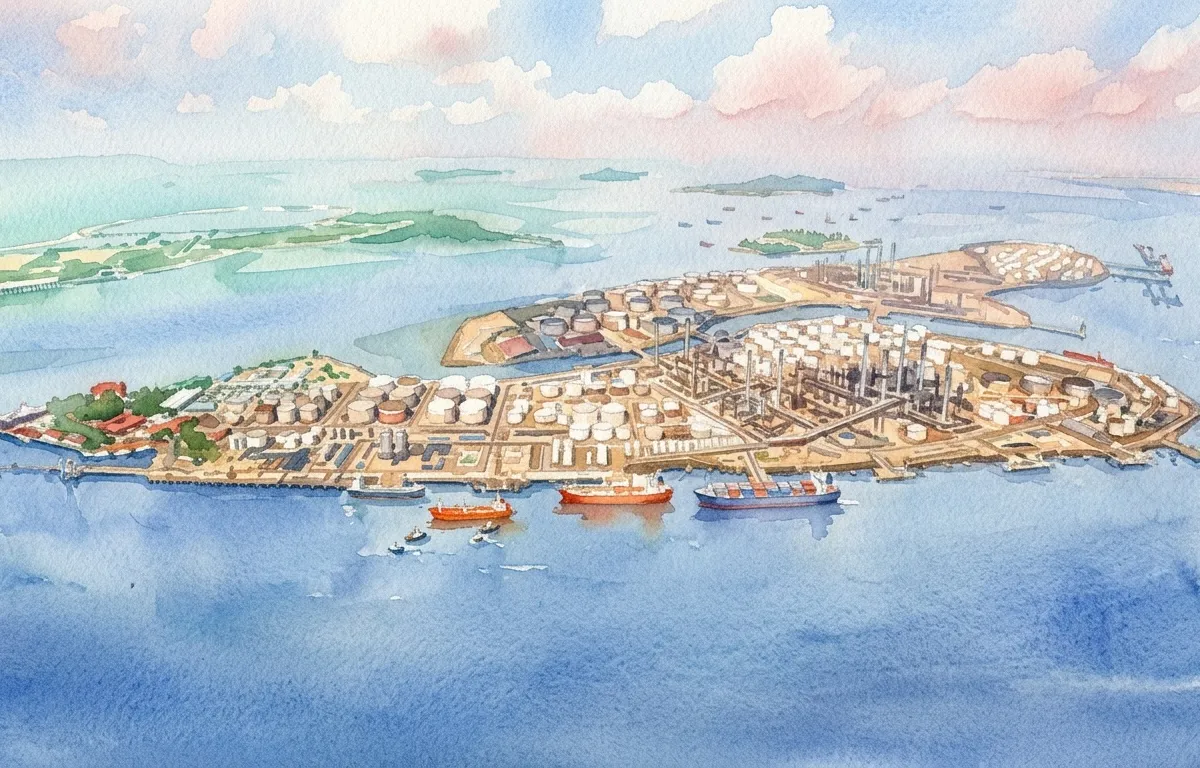
By 1969, 181 factories were running. By the late '70s, oil refineries had set up on a cluster of tiny islands south of Jurong. Three oil majors. Three separate islands. And Singapore was already one of the world's top three refining centres.
Here's where it gets wild.
By the 1980s, the mainland was running out of industrial land. So Singapore did what no one else would even consider.
They decided to merge seven islands into one.
Not with a bridge. With actual land. They filled in the sea between the islands to create a single, massive petrochemical hub.
But the craziest part?
They started selling plots of this "island" to Shell, ExxonMobil, and other oil majors in the early 1990s — before the land even existed.
The EDB convinced the world's biggest chemical companies to invest millions of dollars into plots of open ocean. "Trust us. The land is coming."
And it came. Reclamation started in 1995, officially opened in 2000, and was completed in 2009 — twenty years ahead of schedule.
From 10 sq km of scattered islets to 32 sq km of integrated industrial land. $50 billion in investments. Over 100 of the world's largest energy and chemical companies. 1.5 million barrels of crude oil refined per day.
They even dug underground rock caverns beneath the seabed — 1.47 million cubic metres of storage, the equivalent of 600 Olympic swimming pools — because they ran out of space above ground.
Today, Singapore's petroleum and chemical industries account for roughly a third of its total manufacturing output. Worth over $100 billion.
A country with not a single drop of crude oil in the ground.
Here's the business lesson:
Most people think you need the resource to win the game. Oil countries refine oil. Tech cities build tech. Manufacturing nations manufacture.
Singapore looked at a map, saw nothing, and asked a completely different question: What if the value isn't in having the resource — but in being the best place to process it?
They didn't have oil. So they built the world's best reason for oil to come to them.
They couldn't own the input.
So they became the infrastructure.
This is the LinkedIn edit — written to fit inside 3,000 characters.