Hugh Harrison
The song you'd defend to the death was written by a foreigner you never knew — and you only learned his name when someone tried to steal it.
I can sing "Count On Me, Singapore" from memory. Every Singaporean can.
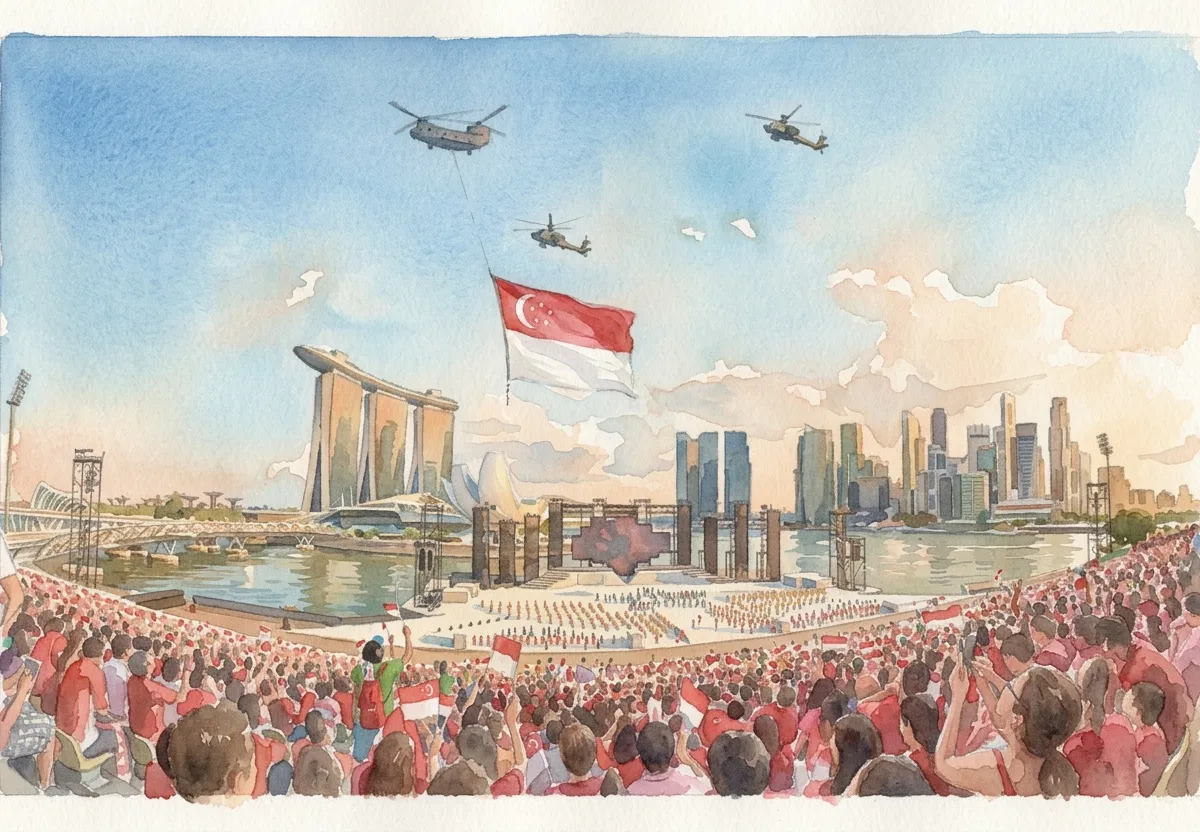
School assembly. National Day. That swell in the chorus where the whole hall lifts and, for three minutes, everyone actually means it. Forty years of it. It's less a song than a reflex.
Here's what I didn't know until recently:
It was written by a Canadian.
His name is Hugh Harrison. A former jazz pianist who worked as a creative at the ad agency McCann-Erickson in Singapore. He didn't just write "Count On Me." He wrote the first three National Day songs — "Stand Up for Singapore" in 1984, "Count On Me, Singapore" in 1986, "We Are Singapore" in 1987. All three. The soundtrack of a nation's patriotism, composed by a foreigner at an advertising firm.
And it started as a pitch. In 1984 the Ministry of Culture invited agencies to bid on a campaign. Harrison got the brief on a Friday, thought about it over the weekend, and on Monday sat at a piano and laid down the demo. The most enduring expression of Singaporean spirit began as a Monday-morning ad job done fast.
Then it just became theirs. Sung by every kid, every August, for four decades. Nobody thought about who wrote it. Why would you? It felt like it had always existed.
But here's where it gets interesting.
In 2021, a composer in Mumbai claimed HE wrote it first. He said his near-identical song, "We Can Achieve," came out in 1983 — three years before Harrison's. His proof? Orphans who supposedly learned it, and documents he said were "washed away" in the 2005 floods. Then he admitted he'd only heard of "Count On Me, Singapore" a few days earlier.
Harrison was furious. His words: "It's insulting to me."
So Singapore had to do something strange. To defend its most beloved patriotic song, the government formally established — in public — that the song was written by a Canadian adman. Singapore's culture ministry said the Mumbai song "appears to have been substantially copied." The composer folded completely. Withdrew every claim, apologised, and conceded the copyright belongs to Singapore.
Think about that for a second.
A whole country learned the name of the man who wrote its anthem only because someone tried to take it.
We spend so much energy guarding what's "ours." The song, the identity, the story. But the thing you'd fight hardest to protect was, quietly, a gift from an outsider who saw the place clearly enough to put it to music.
What's something you'd call yours that someone from the outside actually gave you?
This is the LinkedIn edit — written to fit inside 3,000 characters.